
New CNG Vehicle Incident Response Resource Released on National First Responders Day to Enhance Driver and First Responder Safety
Guide Produced for Inclusion in Vehicle Cabs for Quick Reference in Case of Possible Incident
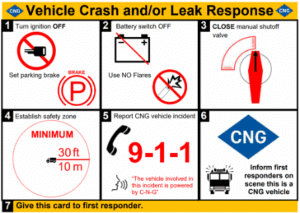
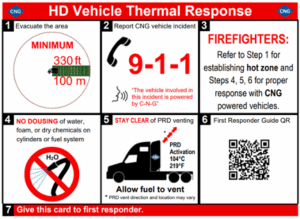
Washington, DC – In support of National First Responders Day on October 28th, The Transport Project (TTP) today released an important safety resource for inclusion in commercial vehicles fueled by compressed natural gas (CNG). The downloadable two-sided safety guide contains detailed “Vehicle Crash and/or Leak Response” instructions on one side with “Vehicle Thermal Response” instructions on the reverse.
The card is meant to be downloaded and/or installed in CNG vehicle cabs for quick reference use during traffic accidents or vehicle fires. Both sides include seven basic steps with graphics and concise language for vehicle drivers to follow to advance the safest possible incident outcome; once emergency services arrive, the card can be shared with first responders.
“TTP’s Technology and Development Committee produced this resource to reduce risk for drivers and improve emergency response outcomes in the immediate aftermath of vehicle collisions or thermal events involving CNG trucks and buses,” said Paul Sandsted, The Transport Project’s Director of Technology and Sustainability. “This card is meant to provide clear, easy-to-read reminder guidance on the most critical steps to undertake during such events when stress levels are likely elevated.”
The resource was developed by TTP’s Technology and Development Committee in consultation with CNG vehicle experts and emergency response professionals. Access the downloadable resource HERE.
“As motor carriers seek to adopt renewable and other alternative fuel powertrains into their fleets, additional training and resources are often vital to maintain safety,” said American Trucking Associations VP of Energy & Environmental Affairs Patrick Kelly. “We support this initiative to equip the cabs of these vehicles with instructional cards. These educational materials will help protect truck drivers and first responders in emergency situations.”
“The Alternative Fuels Council (AFC) and NATSO support the advancement of alternative fuels like CNG and RNG as a transportation fuel. Providing easily accessible safety protocols is a vital component of transporting these fuels safely and securely,” said Alternative Fuels Council Vice President Ginger Laidlaw and NATSO Vice President of Public Affairs Tiffany Wlazlowski Neuman. “These protocols will help ensure that first responders can mitigate and control leaks or thermal incidents while also complying with fuel handling regulations. We are proud to enlist our support in The Transport Project’s initiative to provide instructional cards that advance safety on the Interstate Highway System.”
Additional first responder resources
The Transport Project and its member companies also advance first responder safety through regional training sessions and promotion of a variety of training services and materials for incident first responders:
- Alternative Fuel Vehicle Institute (AFVi) offers an online course that introduces first responders to the essentials of compressed natural gas vehicles: Specifically, how to identify them, and the critical components that first responders must be familiar with, including fuel containers, valves, pressure relief devices and tubing. The course also presents natural gas as a transportation fuel, addressing its properties, characteristics, and safety factors.
- Hexagon Agility’s First Responder Guide: CNG and LNG Vehicle Fuel Systems.
- The National Fire Protection Association (NFPA) offers Alternative Fuel Vehicle Training for fire professionals.
- AFV Educate offers Firefighter Gaseous Fuel Vehicle Safety Training for fire professionals.
- Detailed slides from an October 2021 first responder safety webinar hosted by Hexagon Agility, the National Volunteer Fire Council, and AFVi can be accessed HERE.
TTP fuel system manufacturer members offer access to a variety of CNG system and inspection training materials online:
###
The Transport Project is a national coalition of roughly 200 fleets, vehicle and engine manufacturers and dealers, servicers and suppliers, and fuel producers and providers dedicated to the decarbonization of North America’s transportation sector. Through the increased use of gaseous motor fuels including renewable natural gas and hydrogen, the United States and Canada can help achieve ambitious climate goals and greatly improve air quality safely, reliably, and effectively without delay and without compromising existing commercial business operations. Find out more at: transportproject.org.
NGV news & insights